company

 (800) 366-1884







Guide to Flexible Scheduling With Locum Tenens

For many physicians and advanced practitioners in traditional employment, mandatory call, facility-set hours that shift without warning, and administrative work that bleeds into personal time are the norm. The schedule belongs to someone else, and the toll shows up in the numbers.
Data from the American Medical Association (AMA) found that 41.9% of physicians experienced at least one burnout symptom. Nurse practitioners and physician assistants deal with many of the same pressures, often with even less say over how their schedules are built.
Locum tenens changes that equation in practice, not just in theory. Physicians build a schedule around their own lives instead of a facility’s, and whether locum tenens is the right move for you starts with understanding how flexible scheduling works, which models exist, and how to build one that protects your time.
What Flexible Scheduling in Locum Tenens Actually Looks Like
In locum tenens, the clinician drives the schedule, not the facility. That single shift, control moving from employer to clinician, is what separates locum tenens schedule flexibility from the rigid structure of traditional employment. Two things define that flexibility — who’s in charge of the calendar, and which assignment formats are available to build it.
You Control When, Where, and How Much You Work
Traditional employment sets your hours, your call rotation, and your patient volume before you ever walk in the door. One cross-sectional study on physician burnout and time off found that 70.4% worked during their own vacation time. Locum tenens flips that dynamic, giving clinicians control over several key elements:
- Availability windows: You decide which days, weeks, or months you’re open to work, rather than a facility dictating your calendar.
- Assignment acceptance: You choose which contracts to take based on specialty fit, location, and compensation.
- Work intensity: You decide how full or light your caseload should be at any given time, whether that means back-to-back contracts for maximum income or a lighter pace.
- Breaks between contracts: You can build in deliberate time off to recover, travel, or spend time with family.
A dedicated recruiter makes this practical rather than theoretical. Instead of sorting through open roles alone, physicians and APPs work with someone who learns their specialty, geographic preferences, and desired intensity level, then brings forward assignments that actually fit. Flexibility is also why nearly 29% of physicians choose locum tenens specifically for the schedule control it provides.
Assignment Types That Support Different Scheduling Goals
Different assignment lengths serve different scheduling goals, and physicians and advanced practitioners building flexible careers choose the format based on the outcome they want, not just the logistics:
- Short-term assignments: Ranging from a single weekend to a few months, these deliver maximum variety and built-in time-off blocks between contracts.
- Long-term assignments: Typically 6 to 12 months or longer, these offer predictable income without a permanent commitment to a single facility.
- Telehealth assignments: These offer geographic flexibility and reduce the strain of travel when relocating for in-person work.
Locum Tenens Schedule Models Explained
Scheduling flexibility isn’t one-size-fits-all. The model a clinician chooses should align with their specialty and lifestyle goals, and two patterns dominate the way locum physicians and APPs structure their work.
The Block Model
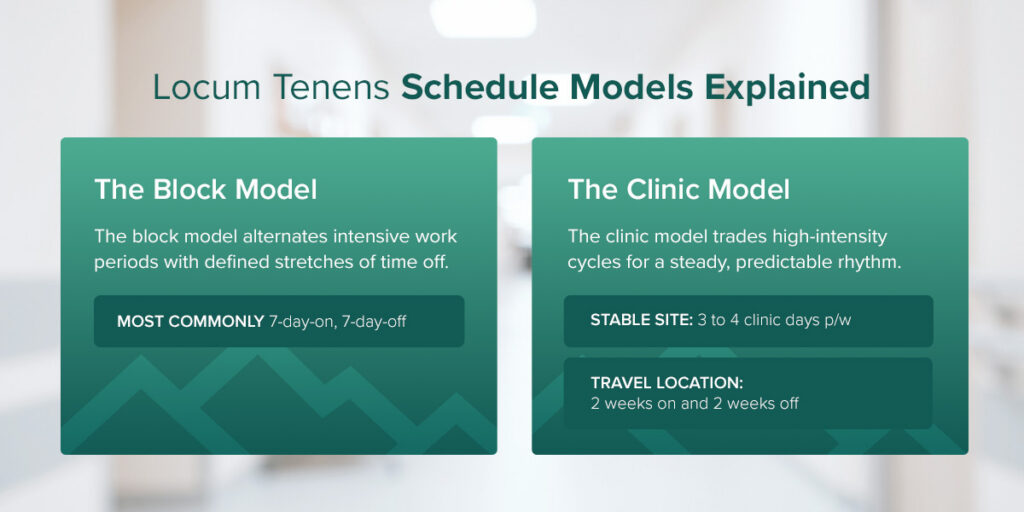
The block model alternates intensive work periods with defined stretches of time off, most commonly a 7-day-on, 7-day-off pattern. Some physicians adjust that ratio, working 5 to 7 days on followed by 7 to 10 days off to accommodate travel or personal projects. Hospitalists, emergency medicine, anesthesia, and some internal medicine subspecialties commonly rely on this model because their work lends itself to concentrated, high-intensity stretches.
The same pattern is common for APPs, including hospitalist NPs and PAs, emergency medicine APPs, and CRNAs working in anesthesia.
Recovery days aren’t an afterthought in a sustainable block schedule. They’re the mechanism that makes the model work over the long term. A 7-on/7-off rotation only supports locum tenens work-life balance if the off period is genuinely protected, not filled with catch-up administrative tasks or on call availability. Physicians building a long-term block schedule benefit from planning those recovery stretches as deliberately as the work stretches themselves.
The Clinic Model
The clinic model trades high-intensity cycles for a steady, predictable rhythm. Physicians typically work 3 to 4 clinic days per week at a stable site, or rotate 2 weeks on and 2 weeks off at a travel location, with hours that stay consistent from week to week. Primary care, psychiatry, and outpatient internal medicine subspecialties commonly use this structure because their patient relationships benefit from continuity.
Nurse practitioners and physician assistants in primary care, urgent care, and psychiatry (including psychiatric mental health NPs) often find this model a good fit for the same reason.
Where the block model asks clinicians to trade intensity for large blocks of personal time, the clinic model offers a steadier pace without the peaks and valleys, appealing to physicians, NPs, and PAs who want dependable structure rather than a permanent role.
Physicians in primary care can review current primary care locum tenens opportunities to see how the model applies to their specialty, and NPs and PAs can view current advanced practice opportunities.
How to Build and Protect Your Ideal Locum Schedule
Real scheduling flexibility is built deliberately, not hoped for. Getting from “I want control over my schedule” to actually having it depends on what a clinician defines before accepting an assignment, and what gets locked into the contract itself.
Define Your Priorities Before Choosing Assignments
Physicians and APPs should go into each assignment knowing what to expect. Schedule control starts before the first conversation with a recruiter. Identifying non-negotiables in advance, such as no overnight calls, a minimum number of days off per month, geographic preferences, or a target intensity level, gives you a clear framework for evaluating assignments rather than reacting to whatever is available. Those priorities then map to specific assignment types and specialties, narrowing the search to roles that genuinely fit.
A recruiter’s role in this process is to match assignments to those stated preferences, not to fill an open slot. Research links full EHR inbox coverage while on vacation and adequate time off to measurable improvements in physician burnout.
Use Contract Language to Lock In Your Boundaries
Flexibility only holds if it’s written into the contract. Before signing, clinicians should confirm that the agreement addresses these key protections:
- Shift days and lengths: The contract should clearly define which days and how many hours you’re expected to work.
- On-call expectations: On-call terms should be spelled out explicitly rather than left implied.
- Cancellation terms: The agreement should specify cancellation clauses that protect both parties.
- Patient volume caps: The contract should establish clear expectations around patient volume.
Navigating that contract language doesn’t have to happen alone. A VISTA recruiter helps physicians work through these details as part of the partnership, while VISTA handles the logistics around licensing, credentialing, travel, and housing so physicians can focus on selecting the right assignment. For a closer look at what to watch for before signing, these tips for reviewing a locum tenens assignment walk through the details to confirm up front.
Build Your Locum Tenens Schedule With VISTA
Building a schedule that protects your time, specialty, and priorities is crucial, and a dedicated recruiter relationship makes that possible. A VISTA recruiter learns your specialty, availability, and lifestyle goals, then matches you with assignments built around those priorities.
That partnership is backed by more than 30 years of experience placing physicians and advanced practice providers nationwide and recognition as a ClearlyRated Best of Staffing Client and Talent 10-Year Diamond Award winner. VISTA also handles logistics like licensing, credentialing, travel, and housing, so you can focus on choosing assignments that fit your life.
Connect with a VISTA recruiter and start exploring locum tenens opportunities with VISTA today.